
Despite being a mere city, Hong Kong has been a bastion of Asian film and television production, influencing and inspiring generations of locals, diasporans, and international filmmakers alike. From Hollywood productions like Rush Hour 2 and The Dark Knight to the local masterpieces of Rouge and In the Mood for Love, this itinerary will guide you to experience Hong Kong through the eyes of acclaimed film directors and observe beauty in different lights.
Ain't nobody got time to read!
We got you! This travel plan is now available as a PDF map. For just US$1, you can download the more convenient format to your device, or even print it out for maximum immersion.
Statue Square

Since its foundation in the late 1800s, Statue Square has seen the rapid transformation of Hong Kong from a colony into a world city.
The current edition was constructed in the 1960s after most bronze statues were plundered by the Japanese army during World War II. Nonetheless, the Square presents an optimal viewing point of architecture old and new in Central. On one hand, there is the Court of Final Appeal, a neoclassical colonial courthouse erected since 1910. On the other hand, numerous iconic skyscrapers including the Bank of China Tower, The Henderson, HSBC Building and IFC clusters in the area, bringing a unique picture frame.
While here, don’t forget to check out the two relief sculptures by Italian ceramic artist Antonio Casadei!
Duddell Street
One of the Declared Momuments, the classic-style staircase creates a charmingly contrasting image among the neighbouring high-rises. Despite being ravaged by Typhoon Mangkhut in 2018, it was carefully repaired with a HK$4 million government budget.
The four lamps gracing the stairs are the only ones still running on town gas in Hong Kong. Every evening, they cast a romantic yellow light onto the scene, attracting local film and television producers, and many wedding couples alike.
You can see the stairs featured in local productions such as:
- 夢伴 (Dream Partner) (1985), a music video starring Anita Mui
- 喜劇之王 (King of Comedy) (1999), a film directed and starring Stephen Chow
Fringe Club
Sitting atop Wyndham Street is an eclectic building with strong neoclassical features and Arts and Crafts influences. Originally a milk depot for a Christian-run dairy farm, this Arts-and-Crafts building was revitalised into an arts venue in 1984, renamed as Fringe Club. Part of the building was also leased to the Foreign Corresponders’ Club in Hong Kong.
Need a break? Fringe Club is, aptly, on the fringe of Lan Kwai Fong, filled to the brim with bars and clubs. We personally recommend Ho Lan Jeng, where you could sample a wide range of craft beer infused with local flavours.
Pottinger Street
Known locally as Stone Slab Street (sek6 baan2 gai1) due to its stone pavements, Pottinger Street is one of the earliest-developed roads in Hong Kong where rickshaws and sedan chairs trekked. Once populated by trade companies, printing shops and barbers, the street is now incorporated into Central’s SOHO area, and is also the prime place to get party supplies and festive ornaments.
The best place to take photos is the street section between Wellington Street and Hollywood Road, where you could get the stone stairs, and the former colonial prison complex in the background.
In 2009, director Teddy Chan recreated a film set of Pottinger Street in its early 1900s glory in Shanghai for the film 十月圍城 Bodyguards and Assassins, a story based on the revolutions leading to the Imperial Chinese government being overthrown.
Need a break? Right on Pottinger Street, you’ll find Messina, a premium gelato place that serves local-inspired flavours including tofu pudding and ginger milk.
Central Mid-Levels Escalator
Widely regarded as the longest outdoor sheltered escalator system in the world, Central Mid-Levels Escalator is the easiest way for you to head into old town Central with minimal walking.
The 800-metre (2,625 feet) escalator and travelator chain takes travellers up to a 135-metre (443 feet) elevation, and connects to major attractions including Tai Kwun and Hollywood Road.
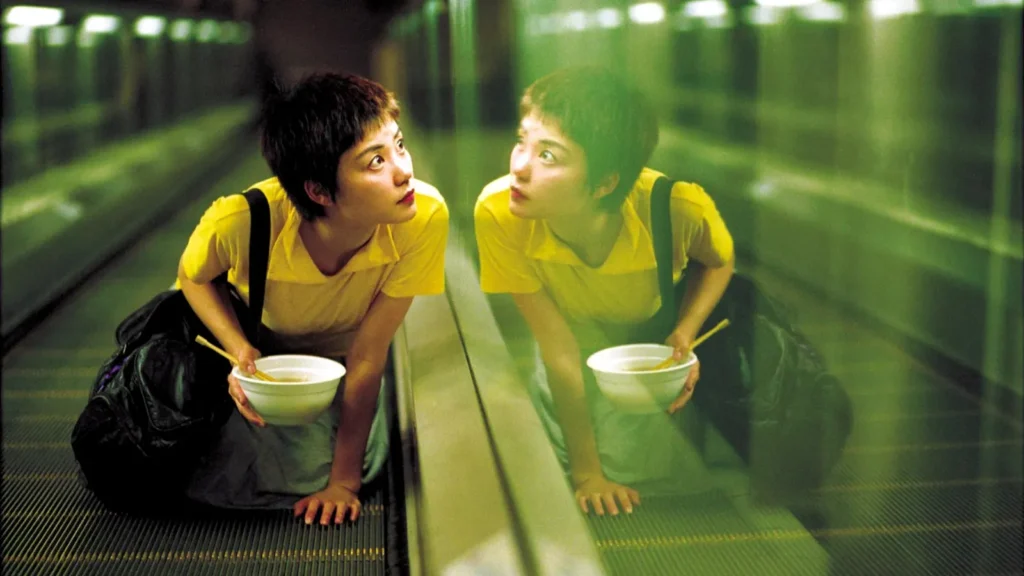
Shortly after its completion in 1993, director Wong Kar Wai employed it as a set for 重慶森林 Chungking Express, a film that propelled him into the international limelight. Even till this day, it’s common to find tourists mimicking the film shots of actress Faye Wong sitting on the travelator and gazing out through the glass, a symbol of the loneliness of city dwellers.
Did you like our Hong Kong cultural travel content? GOOD to GO runs on our passion for the city that nurtured us, and you can support us by buying us a cup of rocket fuel that is Hong Kong-style milk tea!
Tai Kwun
大館 Tai Kwun (which literally translates to ‘big station’) is perhaps the most iconic sight on Hollywood Road. Built in 1841 as Victoria Prison, the complex expanded to include a police station, officers’ abode, and a magistrate. After its decommission in 2006, the premise was revitalised and reopened in 2018 as Central’s prime venue for the arts, exhibitions, and dining.
Among its signature red brick cell blocks and steel walkways hide esteemed bars, restaurants and crafted goods vendors. Apart from exhibitions, the complex walls are also adorned with numerous art installations waiting for you to explore.
Within these walls were the filming spots of 美少年之戀 Bishonen… (1999), an avant-garde Boys’ Love film depicting the ‘forbidden romance’ of a police officer and a sex worker, subverting the conventional notions of masculinity and body autonomy.
Need a break? Tai Kwun houses restaurants offering diverse cuisines. LockCha Tea House provides dozens of Chinese tea selections along with vegan dim sum in an alfresco setting. If you’re looking for a more potent concoction, Dragonfly presents Asian beverage-inspired cocktails under its iconic, mesmerising emerald mosaic decor.
Graham Street / Gage Street
Graham Street was one of colonial Hong Kong oldest outdoor wet markets, which gradually spread to the neighbouring Gage Street. Its aesthetic captured the eyes of quite a few Hollywood productions including Rush Hour 2, The Dark Knight, and Push, to name a few. Wong Kar Wai’s 重慶森林 Chungking Express also featured scenes of the main characters flirting on the streets.
Yeung Ku-wan, then President of the Hong Kong Chapter of the Revive China Society, was assassinated here in 1901. A revolutionary targeted by the Imperial Qing government, Yeung was gunned down near the intersection of Gage Street and Graham Street. This part of history was commemorated by a marker, and immortalised in the film 十月圍城 Bodyguards and Assassins.
Kau U Fong / Gough Street
Filmaholics flock to Kau U Fong for the emblematic stairs featured in 花樣年華 In The Mood For Love, another classic by Wong Kar Wai. Though the stairs have since been renovated, it encapsulates the magic of brushing pass familiar strangers and the brief, subtle intersection of intimate space.
Together with the neighbouring Gough Street, this region was one of the first Chinese settlements next to the racially-segregated Central before the 20th Century. Hong Kong’s first public secondary school, Central College, was also founded in the area. Nowadays, Gough Street and its connecting stairs are often used as community spaces, and one can find street art scattered everywhere.
Wing Lee Street
Wing Lee Street was almost torn down by local authorities until the making of 歲月神偷 Echoes of the Rainbow, a nostalgic film set in the 1960s and celebrates the resilience of the common folk. Since then, nine 1950s post-war residential buildings were preserved and renovated. Sadly, none of the original tenants stayed in these flats, and the buildings were handed over to nonprofits for community use. Still, this terrace is a popular spot for reminiscing old Hong Kong. The nearby Shing Wong Street also boasts a handful of curious shops and cafes.
Bridges Street
At the end of Bridges Street, one can find the Central Chapter of YMCA, another typical colonial building and Declared Monument. Built in 1847, it contained Hong Kong’s first indoor heated swimming pool, and acted as the clubhouse for generations of Hongkonger Christians. The property is currently used as a sheltered workshop and not open to public.
The street section right in front of the building entrance was the filming scene of 大隻佬 Running on Karma, a 2003 local Buddhism-informed production that explores collective karma, the inevitability of death, and survivor’s guilt.
Bonus attraction. Habyt, a coliving solutions provider, operates a tong lau (old Chinese walk-up building) exhibition that allows visitors a glimpse into old Hong Kong living. You can reserve a spot via this Google Form at least 72 hours in advance.
Ladder Street
As the name suggests, Ladder Street is made up of three sections of staircases that go up 70 metres total elevation – not quite a hike, but will certainly take out your breath.
The street is famous for being the filming spot of the 1960 production The World of Suzie Wong, one of the earliest Hollywood films shot in Hong Kong. It also connects travellers to Man Mo Temple, the nearby Chinese Antique Street (Cat Street), and attractions and transportation in Sheung Wan, making the stairs part of every tourists’ path.
Man Mo Temple
Whenever you look up temples in Hong Kong, the incense curls hanging from Man Mo Temple’s ceiling will certainly pop into view. Built in 1847, the temple is one of the oldest since the establishment of Victoria City, and certainly the largest of its kind in Hong Kong.
While basking in the incense and rubbing on the golden deer, you can also admire the interiors and statues that were featured in the 1987 local film 胭脂扣 Rouge, a Romeo-and-Juliet-esque tragedy where the ghost of a famous courtesan searched for the wealthy playboy who was supposed to accompany her into the afterlife. The story makes a nice addition to the many legends surrounding the neighbourhood of Sheung Wan, a place populated by temples, funeral homes, and, if you believe it, ghosts.
Ready for more?
I developed this travel plan for a movie-lover guest from the US. If you’d like to elevate your Hong Kong experience, consider booking a personalised tour!
City Unscripted is an operator I’ve been working with for 3 years. Get a flexible and affordable private tour today!
Tai Ping Shan Street
As one of the earliest neighbourhoods in colonial Hong Kong, Tai Ping Shan Street was once riddled with plague and death. Remnants of its gloomy past could still be found today, such as the existence of three temples on the same street. Nowadays, the area is a local-favourite for its hip, multicultural vibe.
Need a break? Pop in for a traditional Chinese tea tasting session at Yuan Yuan Tang, or a taste of soy sauce Western cuisine at Yuk Kin Fast Food. If you’re looking for a refreshing drink, Craftissimo serves a variety of local and international craft beer.
Hollywood Road Garden / Possession Street
If you don’t have time to cover the impressive Nan Lian Garden, Hollywood Road Garden offers a more convenient taste of Chinese garden design. Immerse yourself into the winding paths, circular door frames and towering banyan trees.
The park connects to the footbridge above Possession Street, the first landing spot of the British Navy in Hong Kong in 1841. The bridge offers an elevated view of Sheung Wan, a trading district known for dried seafood and other premium Chinese ingredients. While here, you can also visit Chu Wing Kee to have a go at treasure hunting for homeware.